
Stretch Ceiling Installation in Commercial Spaces and Swimming Pools: Expert Tips from Professional Installers
November 24, 2026
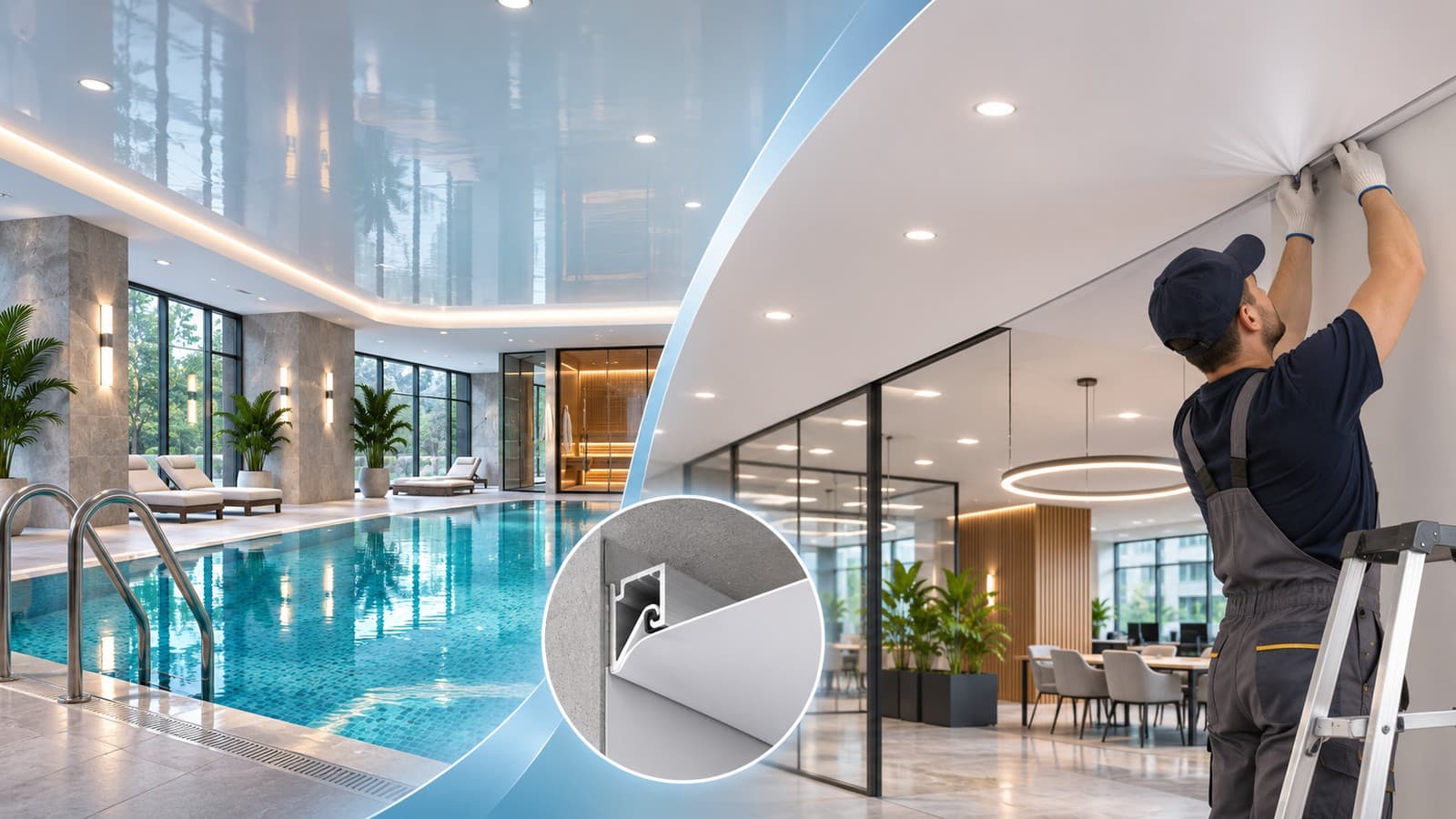
The construction and finishing of commercial properties, public spaces, aquatic facilities, and indoor swimming pools differ significantly from residential renovation projects. In private interiors, the primary considerations are usually visual aesthetics and comfort. Commercial buildings, however, also require compliance with building regulations, consideration of intensive operational loads, assessment of continuous exposure to aggressive environments, and adherence to safety requirements.
Any mistake during material selection or framework design can lead to serious operational problems, costly dismantling work, and reputational damage for the contractor.
In this practical article, we will explore the challenges of working on complex projects, the technical requirements for mounting profile systems, the specifics of installing stretch ceilings in high-humidity environments, and the advantages of professional Briton materials, particularly the flagship Series 270 product line.
Specific Requirements for Commercial Properties and High-Humidity Areas
Indoor swimming pools, spa complexes, fitness centre shower rooms, water parks, restaurants, retail spaces, and offices create specific environmental conditions that require a specialised engineering approach.
Aggressive Environments and Humidity
In swimming pool facilities, relative humidity can reach 70–90%, particularly where humidity control is inadequate. Additionally, the air contains chlorine compounds or other disinfectants used for water treatment.
Low-quality construction materials and inexpensive polymer films may begin to deteriorate within just a few months under such conditions. The membrane may lose its original colour, turn yellow, or develop microcracks, while metal framework components may experience accelerated corrosion.
Mechanical Loads on the Ceiling Perimeter
Commercial spaces are generally much larger than residential rooms. The considerable length of walls in retail spaces and restaurants creates significant tension loads on wall-mounted profiles.
If the framework is incorrectly selected or compromises are made regarding metal thickness, the profile may gradually bend under the tension of the harpoon mounting system. This can result in deformation of the entire ceiling surface.
Regulatory and Sanitary Requirements
Commercial and public spaces are subject to regulatory requirements and inspections. Consequently, finishing materials must comply with applicable sanitary, fire safety, and environmental standards.
Relevant documentation may include SGS emissions test reports, A+ indoor air emissions classifications, and compliance with REACH and RoHS requirements, where applicable.
For this reason, a stretch ceiling in a swimming pool should be designed as a sophisticated engineering system that requires careful attention to quality at every stage of installation.
Engineering Requirements for the Moisture Resistance of Briton Materials
Professional installers rely on proven solutions to successfully complete projects in commercial and high-humidity environments. Briton's flagship product line, particularly Series 270, is designed to meet demanding operating conditions.
Its key material characteristics include:
- Chemical resistance of the membrane. Briton film does not absorb moisture and is designed to withstand exposure to demanding indoor environments, including temperature fluctuations and common cleaning products.
- Resistance to mould and mildew. Thanks to its dense structure and non-porous surface, the material does not readily absorb moisture, reducing the conditions favourable to microbial growth on the membrane itself.
- Environmental safety. A+ indoor air emissions classification, SGS testing, and compliance with applicable REACH and RoHS requirements make the material suitable for consideration in healthcare facilities, children's institutions, and premium commercial spaces.
When properly installed and operated under appropriate environmental conditions, moisture-resistant Briton stretch ceilings can retain their original elasticity, appearance, and colour for many years.
Profile Strength Requirements and Mounting Framework Systems
The quality of a stretch ceiling depends not only on the membrane itself but also on the correct selection and installation of the mounting profile. Commercial projects require particular attention to framework strength and structural reliability.
Why Should Lightweight or Plastic Profiles Be Avoided?
In large commercial spaces, the tension exerted on wall-mounted profiles can be substantial. Plastic profile systems or low-quality thin aluminium profiles may gradually deform, detach from the wall, or break at the corners under excessive loads.
Key framework installation recommendations for commercial properties:
1. Large-area ceilings and complex spaces require rigid aluminium profile systems, such as shadow-gap, gapless, or reinforced standard wall-mounted profiles capable of maintaining their geometry over extended periods.
2. While residential installations commonly use fixing intervals of 20–25 cm, commercial projects and high-humidity areas with tiled walls may require intervals as short as 10–12 cm. The exact spacing should be determined according to the profile manufacturer's specifications, substrate strength, and calculated loads.
3. In swimming pool facilities, profiles and fixing components should feature appropriate corrosion protection. Compatible moisture-resistant sealants may also be used where required by the installation design.
During professional stretch ceiling installation, attention to every framework detail is essential for minimising future defects and warranty claims.
Practical Installation Tips for Complex Projects
Briton's experience with large-scale commercial projects highlights several important technical considerations.
Inspection and Waterproofing of the Structural Ceiling
Although high-quality PVC stretch ceiling membranes are water-resistant, the structural ceiling above them requires careful preparation.
Before installation in a swimming pool facility, concrete surfaces should be inspected and, where appropriate, treated with antifungal primers and suitable moisture protection systems.
Condensation caused by temperature differences between the swimming pool and an unheated technical floor above can gradually damage existing plaster and other structural ceiling finishes.
Ventilation of the Ceiling Void
In indoor swimming pools and spa facilities, particular attention should be paid to ventilation within the ceiling void.
Where required by the ventilation design, air diffusers or ventilation grilles can be integrated into the stretch ceiling membrane and connected to the building's ventilation system.
Properly engineered airflow and humidity control help prevent moisture accumulation, condensation, mould growth, and corrosion of structural components.
Accurate Assessment of Temperature Fluctuations
Commercial buildings often feature large panoramic windows that are exposed to intense sunlight during the summer months.
Using high-quality Briton membranes with stable material properties helps minimise the risk of ceiling sagging or deformation caused by local temperature fluctuations.
The combination of correctly selected stretch ceiling profiles and premium Briton roll materials allows installers to implement ambitious architectural projects across a wide range of commercial environments.
Conclusion
Working with stretch ceilings in commercial buildings and high-humidity facilities requires advanced engineering knowledge and a responsible approach to material selection.
The use of certified Briton membranes, compliance with reinforced framework installation procedures, and careful consideration of indoor environmental conditions are essential for achieving reliable, long-lasting results.
A professional approach ensures consistent installation quality, reduces maintenance requirements, extends the service life of the ceiling system, and protects the installer's professional reputation.